Circuit breakers – operating principle, types, and safety recommendations
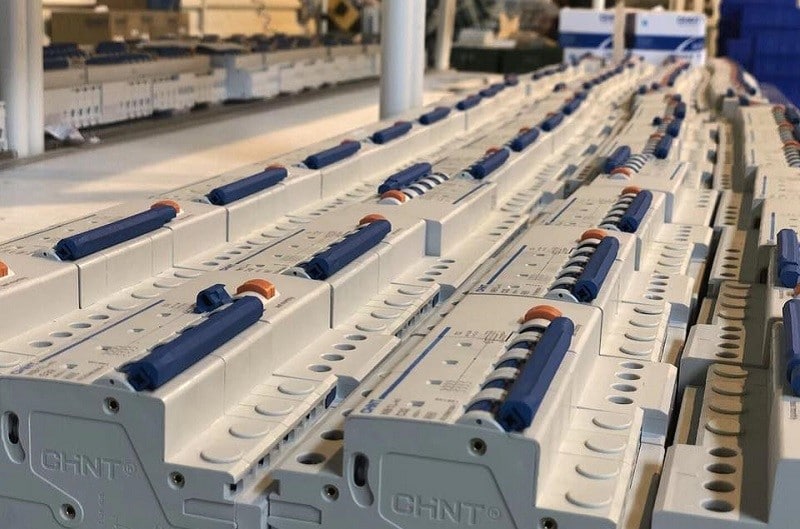
In both homes and businesses, sudden electrical faults often occur which, if not resolved quickly, can cause serious damage to the electrical infrastructure of the site and may even lead to dangerous accidents and fires with destructive consequences.
What do circuit breakers do?
Let us take a house as an example. A house has a main electrical circuit, which consists of several smaller circuits. The circuit in your home is powered by electricity coming from the power plant.
Under normal conditions, electric current is regulated within safe limits or voltage limits (electrical pressure). This is important because excessive electrical load can damage various components of the system.
However, sometimes and for different reasons, the electrical load may rise to levels higher than the circuit can withstand, which can damage both the circuit and connected devices, and may even start a fire.
The main function of circuit breakers is to constantly “check” that the electrical load does not exceed safety limits and, if it does, to automatically interrupt the operation of the electrical circuit in order to prevent damage to the overall electrical installation.
Operating principle of circuit breakers
Internally, circuit breakers mainly consist of fixed and moving contacts, as well as an operating coil.
Under normal conditions – in a closed circuit – these contacts touch each other and allow electric current to flow. The moving contacts are held together by mechanical pressure, which is created by a mechanism such as a spring or compressed air.
This pressure applied to the moving contacts is made possible by potential energy stored in the mechanism. When an overload occurs in the electrical circuit, the operating coil becomes energized, and a device connected to the moving contact mechanism allows this energy to be released, causing the moving contacts to separate.
As the moving contacts separate, the circuit inside the breaker opens, the current flow is interrupted, and the system is protected from further damage.
It is also important to understand the concept of an “arc”.
When electric current passes from an energized component to a neutral component through an air gap, a plasma discharge called an arc is formed. For example, lightning is a very large electrical arc passing from a cloud to the ground or to another cloud.
Arcs can also occur in household wiring and inside circuit breakers, and if not controlled, they can damage devices and cause fires.
Therefore, the mechanism of circuit breakers is designed to prevent or control the formation of such electrical arcs as much as possible.
Types of circuit breakers
There are various types of circuit breakers on the market, but in general they all operate on the same basic principle described above. The difference between models mainly lies in the type of mechanism that activates the separation of moving contacts and the method of arc control.
Molded Case Circuit Breakers (MCCB)
Molded case circuit breakers are mainly used in low-voltage circuits. In this model, all current-carrying parts, mechanisms, and switching devices are housed inside a molded insulating enclosure.
MCCBs are often the first choice in industry for alternating current (AC) or direct current (DC) systems, and their main advantages include easy integration with other control devices, low maintenance cost, and compact size.
Vacuum Circuit Breakers (VCB)
In VCBs, the interruption of electric current takes place inside a ceramic structure called a “vacuum chamber”. This chamber is fully insulated and contains a high vacuum.
Inside this chamber are fixed and moving contacts. When the contacts separate, an electric arc is formed, and due to the vacuum and dielectric strength, the generated heat is extinguished very quickly.
The main advantage of VCBs is that they significantly reduce fire risk and require less maintenance.
Air Circuit Breakers (ACB)
Air circuit breakers contain compressed air inside them. This air is released through a nozzle, creating a high-speed air flow. It is this air flow that extinguishes the arc.
ACBs are generally used in high and medium voltage applications, typically up to 15 kV, or in open-air lines of 220 kV and above.
Their main advantages are compact size, fast response, low maintenance, and significantly reduced fire risk.
Oil Circuit Breakers (OCB)
OCBs are the oldest type of circuit breakers and use oil as the insulating medium for arc extinction.
In this model, switching contacts are placed in oil, and in case of a fault the contacts open inside the oil. The resulting arc creates a hydrogen bubble around it, and the resulting pressure prevents re-ignition of the arc.
The main advantage is that no additional devices are required to control the arc, and the oil also provides insulation between contacts.
Sulfur Hexafluoride Circuit Breakers (SF6CB)
The main feature of SF6CBs is the use of sulfur hexafluoride gas (SF6). This gas has excellent insulating properties and makes the device highly efficient.
In addition, SF6 gas recovers quickly after arc extinction and provides better cooling than air. Therefore, SF6CBs are very effective in medium and high voltage systems, and the gas is non-flammable.
Electrical safety recommendations
When working with electricity, it must always be remembered that there is a risk of electric shock, which in some cases can be fatal. Therefore, the following rules must be observed:
Check circuit breakers in your home or workplace at least once a month. These devices usually have a test button. If the lever does not move when the button is pressed, the device is faulty.
Never use electrical devices barefoot, and do not operate switches with wet hands or wet feet.
Before repair work, always cut off the power from the electrical panel and use insulated tools.
In old systems, inspection and maintenance by a professional electrician is recommended.
Do not work near electrical lines on rooftops during stormy or windy weather.
Whenever possible, use a separate socket for each device and avoid T-splitters.
Before any intervention, switch off the system and verify that there is no voltage.
Do not use damaged cables, as even minor damage can create a risk of electric shock or fire and must be replaced immediately.
