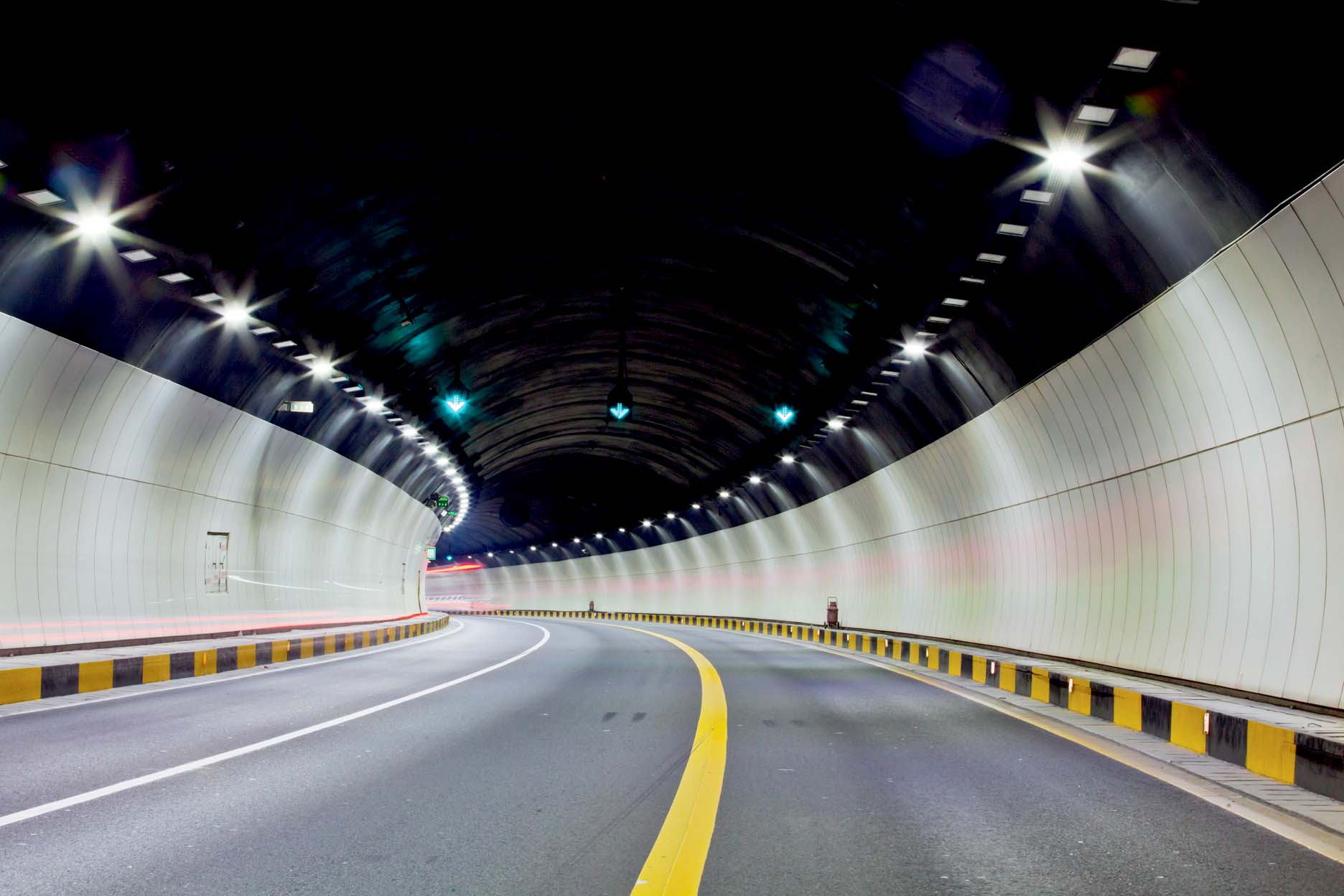
Tunnels are considered one of the most complex and expensive infrastructure facilities.
Their advantages, such as fast and reliable transportation, time savings, and sometimes connecting places that would otherwise remain unconnected, make them necessary and desirable infrastructure facilities despite high financial investment. We should also not overlook the reduction of negative environmental impact from open road traffic, which has become increasingly important in recent years.
A good tunnel is safe, so ensuring safety and regulating uninterrupted traffic flow is essential.
The purpose of tunnel lighting is to provide the same level of safety and comfort for road traffic inside the tunnel as on open roads.
In tunnels where maintenance access is limited, the reliable operation of lighting systems is of great importance. One of the conditions that complicates the tunnel lighting process is the presence of high humidity in the air and exhaust gases, which together can lead to the formation of sulfuric or nitric acid. In such environments, the risk of lamp damage is high. Regular maintenance can resolve issues, but closing the tunnel for such work is not practical due to logistical reasons and high costs.
In such harsh environments, the design and quality of lamps are very important, helping to protect them from the penetration of fine particles and acids, ensure vibration resistance, and reduce the likelihood of physical damage or overheating.
Tunnel lighting zones and their importance
Tunnel lighting zones and their importance
A prerequisite for any safe movement and the main task of a tunnel lighting system is to provide the driver with complete visual comfort at every stage of the journey. Tunnel lighting zones are defined according to the driver’s visual perception needs during driving.
1. Approach zone
the part of the open road before entering the tunnel, and its length corresponds to the stopping distance required for the planned speed of travel. Lighting in this zone may be higher or lower than inside the tunnel (depending on time of day, season, and weather conditions).
During the day, the high contrast between intense outdoor light and the darker tunnel interior strains the driver’s eyes and reduces the ability to perceive obstacles. Due to the significant reduction in the field of vision from a wide open space to the narrow tunnel entrance, a condition known as the “black hole effect” occurs in this zone — the driver temporarily cannot perceive the interior space of the tunnel. In this case, to ensure optimal visibility conditions, it is necessary to provide sufficient lighting in the first, entrance, and tunnel zones for an appropriate length.
At night, the opposite situation occurs: the driver must adapt from driving on an unlit road to entering a lit tunnel. For gradual visual adaptation, it is important that the entrance zone is illuminated by street lighting and that the lighting level is lower than inside the tunnel itself.
2. Adaptation zone
is responsible for adjusting the lighting inside the tunnel itself and consists of the threshold zone and the transition zone. The total length of the adaptation zone depends on the traffic speed and the lighting parameters of the approach and inner tunnel zones it connects.
The threshold zone is the first section of the tunnel entrance. Typically, the frequency of traffic accidents in this zone is higher than in other zones, and it is very important to create conditions that allow timely detection of possible obstacles.
The transition zone continues beyond the threshold zone, where light intensity gradually decreases further until it reaches the lighting level of the inner tunnel zone.
3. Inner tunnel zone
is the area far from the influence of natural light. The goal is optimal artificial lighting that meets all parameters necessary to provide stable visibility for safe movement.
4. Exit zone of the tunnel
as well as the entrance zone, is an area of visual adaptation for drivers from internal conditions to external conditions. In daytime conditions, this adaptation is shorter for shorter tunnels and usually does not require additional lighting. However, in the case of long tunnels, it is necessary to gradually increase lighting linearly toward the tunnel exit along the road.
Additional factors in tunnel lighting
Additional factors in tunnel lighting
To ensure high-quality tunnel lighting, it is necessary to have a good understanding of the characteristics of this infrastructure facility. The design solution must take into account the position and orientation of lighting devices, the tunnel cross-section, permitted speed, entrance conditions, and road construction. Lighting devices in tunnels are mainly arranged in linear form, parallel to the tunnel axis, at appropriate intervals. When lighting devices are placed at the center of the tunnel arch, additional rows of lighting are usually installed in the entrance and transition zones to improve illumination of the tunnel tube.
The reflective properties of materials used in wall and road construction also play an important role in lighting quality and energy efficiency. Therefore, concrete is used on tunnel roads instead of asphalt, as it provides higher diffuse reflection.
No two tunnels are the same, so each one must be designed considering its own characteristics. There is no global standardization for tunnel lighting. In design, recommendations from the International Commission on Illumination CIE-88 (Guide for the lighting of roads, tunnels and underpasses) are used, and many countries rely on their own recommendations and standards for tunnel lighting.
LED lighting in tunnels
LED lighting in tunnels
The use of the latest generation LED light sources instead of traditional light sources is a better and more practical option for tunnel lighting. Long service life, more adequate optical performance, and excellent color rendering are just some of the features of LED lighting, making it an ideal solution for tunnel illumination. The instant ignition of the light source allows for more efficient control and regulation of luminous flux.
