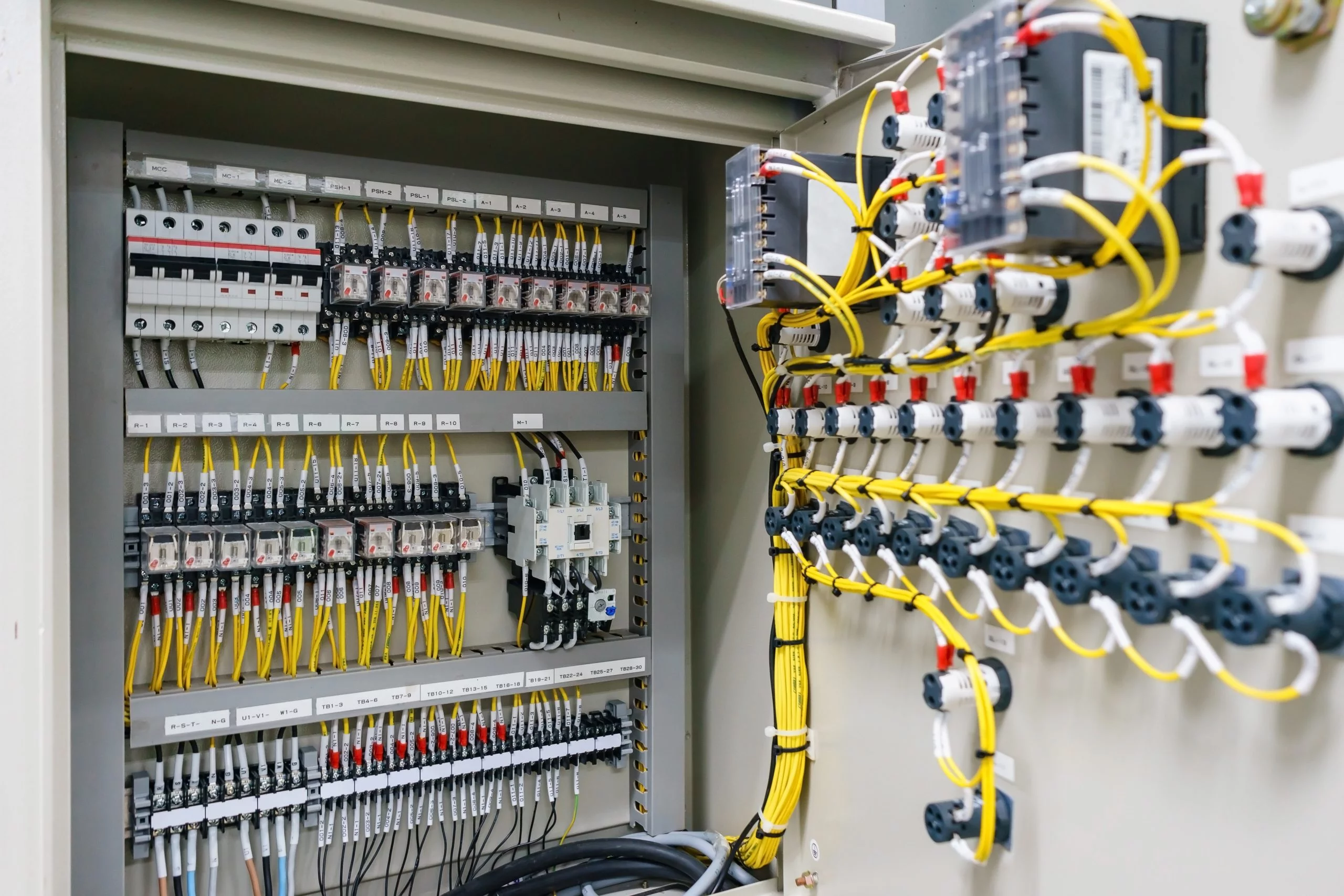
A modern electrical panel is like a highway junction for your home.
It performs two essential functions: it delivers electricity to the outlets and devices in your home and prevents overloads that could cause fires.
To power your devices, electricity usually starts at a power plant. It travels long distances through high-voltage wires—those tall towers that many homeowners see outside their windows—then passes through a transformer at a substation that reduces the voltage, and later through another local transformer, often seen as large “boxes” on utility poles along the road, where the voltage is reduced again. Finally, electricity flows through power lines into your home’s meter and breaker panel. At the start of its journey, the voltage can measure in the thousands, but it is reduced to 120V or 240V at your panel—the perfect amount for your home to function.
Today, most homes have a typical breaker panel located in the basement, utility closet, or garage. It is a gray metal box with a door. The main circuit breaker is located at the top and can shut off all power to your home. Power from your meter flows into the main breaker. Below it are two vertical rows of circuit breakers that distribute electricity to different parts of your home. Your panel may be labeled “Dining Room,” “Kitchen Lights,” “Master Bedroom,” and so on. High-energy devices such as HVAC systems or electric stoves may have their own dedicated breakers. The panel cover protects the live connections that carry electricity from the utility meter into the panel. Always keep the panel cover closed.
How Home Electricity Works
To understand home electricity, let’s start with basic terminology.
• Voltage: the electrical force that pushes current through a wire, measured in volts.
• Current: the flow of electrons through a wire, measured in amperes (amps).
• Power: electrical power in a circuit equals voltage multiplied by current. The higher the voltage (push) and current (electron flow), the greater the power, measured in watts. 1000 watts = 1 kilowatt.
• Energy: the amount of electricity a device uses over time, expressed in kilowatt-hours (kWh).
• Resistance: the measure of opposition to current flow, measured in ohms.
In other words, if you are pushing a high current through a circuit with high resistance, you must increase the voltage. The human cardiovascular system provides a good analogy: blood flow rate is the current, blood vessels provide resistance, and the heart supplies the pressure (voltage) to keep blood moving.
Understanding this terminology is useful because electrical panels are rated in amps and volts, devices and lighting are rated in watts, and utility companies charge you based on the kilowatt-hours your home consumes.
How the Panel Manages Electricity
You may remember that circuits were once protected by round, screw-in fuses that had to be replaced each time they “blew.” Modern electrical panels use circuit breakers that do not need replacement over the life of the panel. Older homes were typically designed for a maximum of 100 amps. Newer homes with larger and more numerous electrical devices may require 200 amps or more.
Electricity in your home is divided into circuits. Each circuit covers a specific area of the home and all the electrical devices within that area. Each breaker in the panel operates within a specific limit based on its amp rating. This also applies to the main breaker. So, in a 200A panel, if your home uses more than 200 amps, the main breaker will trip, minimizing the risk of sparks or fire.
When a breaker trips due to an overload, it moves to a middle position between on and off, stopping the flow of electricity—similar to switching a light on and off. To reset the system—after unplugging some devices to reduce the load—you turn the breaker fully off and then back on. It makes a distinct clicking sound familiar to most homeowners.
If you are expanding your home, upgrading to a large electrical appliance, or purchasing an electric vehicle, you may need to upgrade your breaker panel to handle the increased load. If your main breaker trips frequently, that may also indicate the need for an upgrade. Upgrading from a 100-amp panel to a 200-amp panel can cost between $3,000 and $5,000. Additionally, if your panel has no space for extra circuits, a licensed electrician can install a subpanel to expand capacity without changing the overall service level.
Once electricity enters your home and is used by your devices, any remaining electricity flows back out through the electrical grid.
